FISCAL TRANSFERS ARE NORMAL
27 May 2026
Scotland benefits from much higher public spending per head than the UK average while generating average levels of revenue. The fiscal transfer in Scotland's favour this implies is the source of much debate. Some nationalists challenge the very fact of its existence by asking "if that were true, why would England tolerate it?". One way of answering that question is to look at other fiscal transfers that take place within the UK. Fiscal transfers are normal; Scotland is not an outlier.
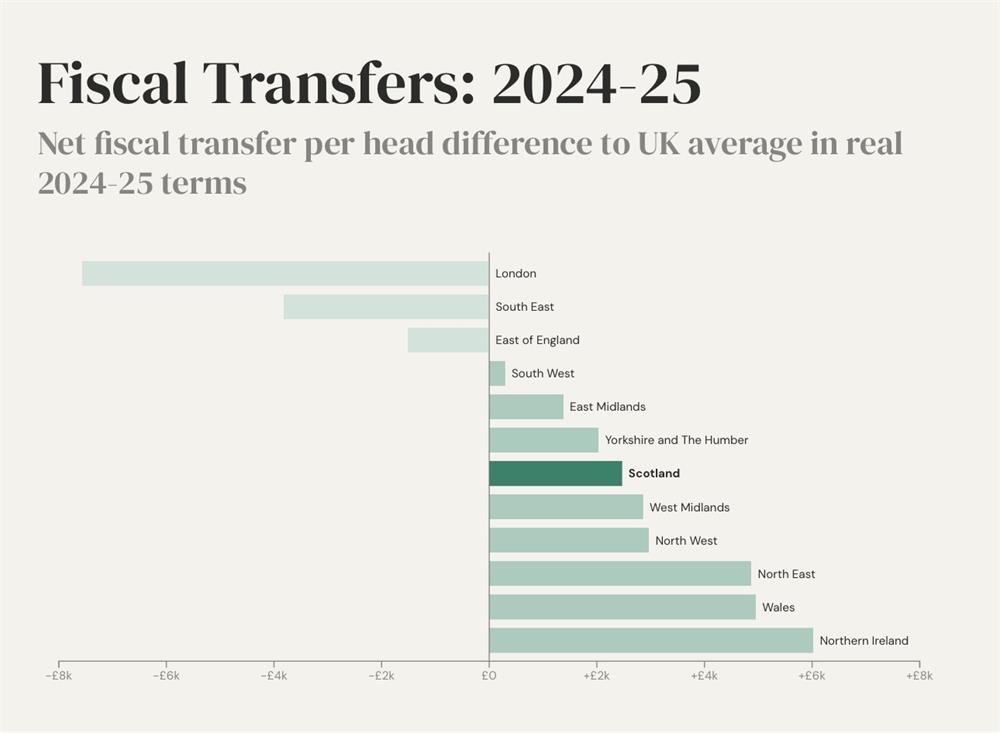
Every year the Scottish Government produces the Government Expenditure and Revenue Scotland (GERS) report which details Scotland's fiscal position. For over a decade this has shown Scotland being a net beneficiary of pooling and sharing tax revenues across the UK, mainly because Scotland benefits from far higher public spending per head than the UK average. But what is often missing from this debate is the wider UK context: how do Scotland's levels of tax and spend compare to the other devolved nations and English regions?
To answer this question we can turn to the ONS Country and Regional Public Sector Finances data. This provides annual revenue and expenditure data by UK nation and region (the Scottish figures reconcile closely with those in the GERS report).
The following charts present the ONS figures on an inflation-adjusted per head basis and show each region's difference from the UK average over time. The implied Fiscal Transfer to or from each region is explained in terms of Revenue attributed to that region (Scotland is allocated a full geographic share of North Sea revenues) and Spending allocated to that region.
London and the South East are the only regions that consistently generate revenue per head above the UK average. Revenue shortfalls are, by definition, largest in regions with weaker economic output. Scotland typically generates close to average revenue per head with year-on-year variations largely driven by oil revenue.
The main beneficiaries of higher public spending per head are London and the devolved nations. These figures reflect only identifiable expenditure that directly impacts each nation and region; they exclude shared UK-wide costs like defence, which the ONS allocates on a per capita basis and which therefore cannot drive regional differences.
Regional revenue and spending differences per head lead to these implied fiscal transfers. If it helps, think of this like diners sharing the cost of a meal: Spending is what your meal cost and Revenue is what you paid for it - your Fiscal Transfer is the gap between what your meal cost and what you put into the pot, both relative to the average.
Northern Ireland, Wales and the North East consistently receive the largest implied Fiscal Transfers per head. Scotland is a consistent beneficiary but not an outlier.
Conclusion
The UK operates as a fiscal union: most tax revenue is pooled centrally, and public spending is allocated across regions according to need and policy. This means some regions are net contributors — they raise more than they receive back in spending — while others are net recipients. There is nothing unusual about Scotland in this respect.
Understanding why a region is a net recipient matters. A region that receives large transfers primarily because of weak revenue (low economic output, low wages) faces fundamentally different policy challenges (and potential grievances) than one that receives transfers because of high spending per head.
Scotland stands out because its fiscal transfer is dominated by the spending component: public spending per head in and for Scotland is consistently and significantly higher than the UK average. This contrasts sharply with Wales, the North East, and Northern Ireland, where weak revenue (i.e. weak economic activity) is the primary driver.
This context is highly relevant to the independence debate. Were Scotland to become independent (or to operate on a fiscally autonomous basis within the UK) then this fiscal transfer would disappear. Instead, a fiscally autonomous Scotland would either be trying to sustain a much larger debt-funded deficit than the one it currently shares within the UK or, more likely, be forced to dramatically cut public spending to achieve a sustainable deficit level. Nationalists may argue that Scotland could replace the fiscal transfer by generating vastly superior tax revenues, but no credible mechanism or timeframe to achieve this has been put forward.
***
Further analysis of the ONS Country and Regional Public Sector finance data which underpins the charts included in this article can be found here
Please log in to create your comment